

Sudoku puzzles are based around a grid, into which you have to place numbers in the right squares. Most Sudokus are 9 squares by 9 squares (although other varieties are possible), and are subdivided into nine boxes each of 3 squares by 3 squares.
The idea behind the puzzles is that each of the squares should contain a number from 1 to 9. There are just three restrictions:
The combination of these three rules, where each number must appear once and only once per row, column and box, allow you to figure out where the numbers are allowed to go.
Each puzzle you see starts off with a different position, with a different number of numbers already filled in at the start. There should be only one solution which fits, so the problem is just filling in the rest of the numbers!
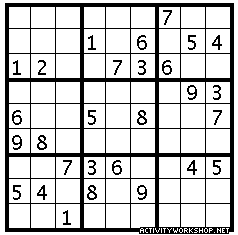
The picture to the right shows an example of a sudoku, with some of the numbers filled in. The rest is just logic and a methodical approach, filling in numbers as you work them out, until the grid is complete. Don't be scared of the maths, because there isn't any - you don't ever have to add up or multiply the numbers together, just make sure that each number appears where it should.
There are various tricks you can try to work out which numbers go where, and these are outlined in the tutorial including simple examples.
As part of the Activity Workshop, there's an applet game (a bit like the Nonograms one), where you can have a go of the puzzles yourself in the browser, and the game will warn you if you've gone wrong. It also lets you undo your moves easily and gives visual highlighting clues. You can read more about the helper to find out how to use it, or if you're brave enough to jump right in you can try out the first of the ten puzzles here, Puzzle 1.
You can also use this helper gadget to solve any puzzle that you find in the newspaper for example - just go to the blank sudoku and fill in the starting numbers yourself.
Can't remember which ones you've finished already? Check out your progress.
There are, of course, times when pen (or pencil) and paper are all that are available, and maybe you want to take a Sudoku
and solve it later on paper. Having a pre-prepared sheet can be handy then, so you can copy the numbers across and start solving.
It can also be convenient if you've gone wrong on a paper Sudoku and want to start again. You can download this simple
PDF file (10 kb) which contains four blank grids, and print it out for your own
worksheets.
With anything as popular as the sudoku phenomenon has become, there are bound to be variations invented to make it more interesting. The simplest variation is to not use numbers 1 to 9, but either smaller or larger grids. Up to 16 by 16 is about as big as they get, using hexadecimal values (0-9 and A-F) in each of the four-by-four-by-four-by-four cells. Kids can practice with four or six-valued sudokus too.
One more complicated variation is the "X-Sudokus", or "Samurai Sudokus", where five normal Sudokus overlap each other. These can get tricky and obviously take a while to complete. There are a couple of examples for you to try out here now.
Another major variation to Sudokus is the so-called "Killer Sudoku", whereby the grid has no numbers filled in for you at the start. Instead, dotted lines are drawn grouping certain squares together, and the sum of these squares is given.
Difficulty of these "killers" varies greatly, and the logic paths for calculating the squares' values can become especially tortuous. Listing the possibilities of squares can be a particularly useful tactic. The links given by the Wikipedia article contain examples to try yourself. Also the Kakuro cheat sheet can come in handy to work out the possibilities, as the combinations are the same. Because the killer sudokus are a bit like a cross between sudoku and kakuro in that respect, some people call them "kakudokus" or "sumdokus" too, thereby neatly avoiding the puerile sound of "killer sudoku".
Taking the sumdokus idea even further, the next level is called "kenken" or "mathdoku" - the idea is the same as the killer sudoku but there are not just sums in the cages, there are multiplication, subtraction and division too. The result and the operation are then given for each cage, for example "2-" in a cage of two cells mean that one number minus the other gives the answer 2. There is (as always) more information at wikipedia:Kenken. Note that in some of these puzzles, the usual rule that a number can't be repeated inside a "cage" isn't always observed, so for example you could get a three-cell cage with the clue "3x" - that means the product of all three numbers must be 1. In that case the only answer can be "1, 1, 3" where the two 1's must be diagonally opposed to each other (they still can't be in the same row or column).